
How Does AI Search Work?
An excerpt from “Acing AI Search: How Earned Media and Regular Press Lead to AI Optimization for Brands,” Rock Paper Scissors’ new guide to AI Search. Scroll down to get the full white paper.
Search has changed. Even on Google, AI and chatbots are getting between your customers and discovery of your company’s products and services. And like most marketers, you’re likely wondering what to do to change that.
Whether you call it AIO (AI optimization) or GEO (generative engine optimization), SEO in the age of AI search is on every marketer’s mind. As people turn to LLMs and chatbots for recommendations, you want to make sure your company and offerings are properly represented--or mentioned at all in the resulting response.
There’s a highly effective way to do this: Get regular press. Recent research shows that the fastest way to get into AI outputs is also the oldest way of getting the word out about your business, earned media. That means earning coverage in respected and authoritative news and trade media outlets.

Want chatbots to find your company?
You need regular press.
Earned media, AKA news outlets, remain key pillars of any promotional strategy, especially in the age of AI. Third-party validation matters more than ever, and the more of it you earn, the better your chances of appearing in AI outputs. There are a limited number of media outlets who cover news well, and the bots know it. They favor them when they calculate what response best matches your query.
What sources does AI search pull results from?
Four researchers from the University of Toronto recently published one of the first studies systematically comparing traditional SEO and GEO. They tested both Google search and a variety of AI models across verticals including cars, electronics, and software, using a variety of prompts in several geographic markets.
Then:
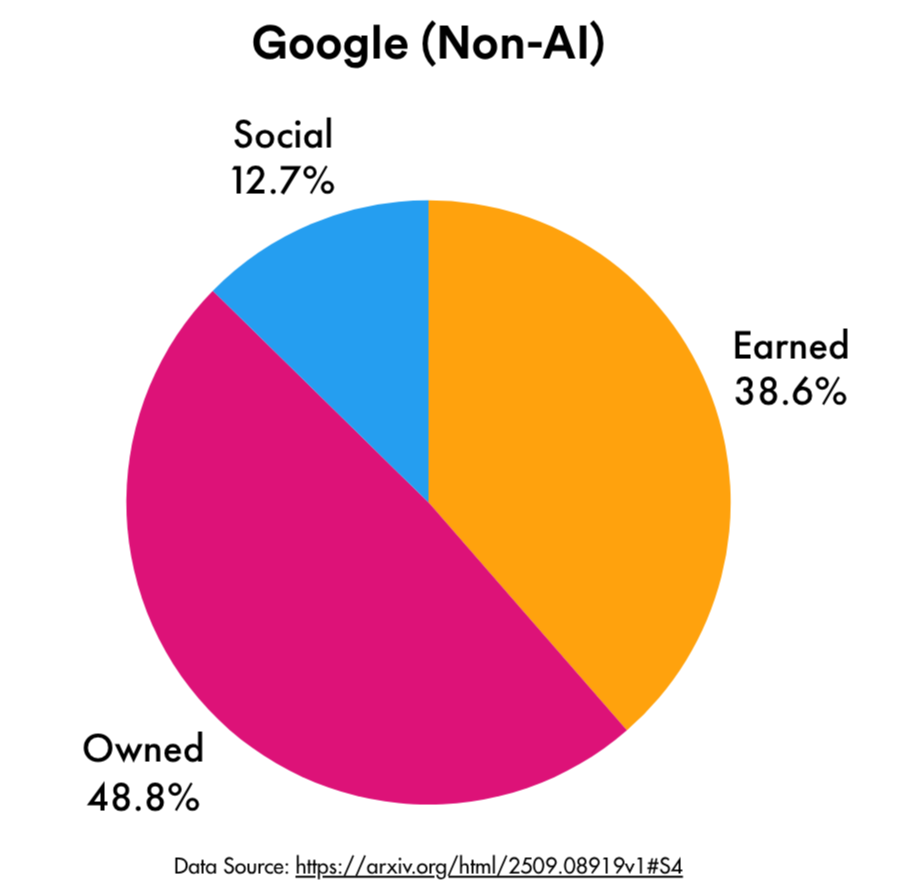
Classic Google Search used a balance of owned media (what you have on your blog), social media, and earned media (what journalists say about you).
We’re all familiar with SEO and the mix of factors that determine it. Classic Google Search, for example, uses a balance of owned media (what you have on your blog), social media, and earned media (what journalists say about you).
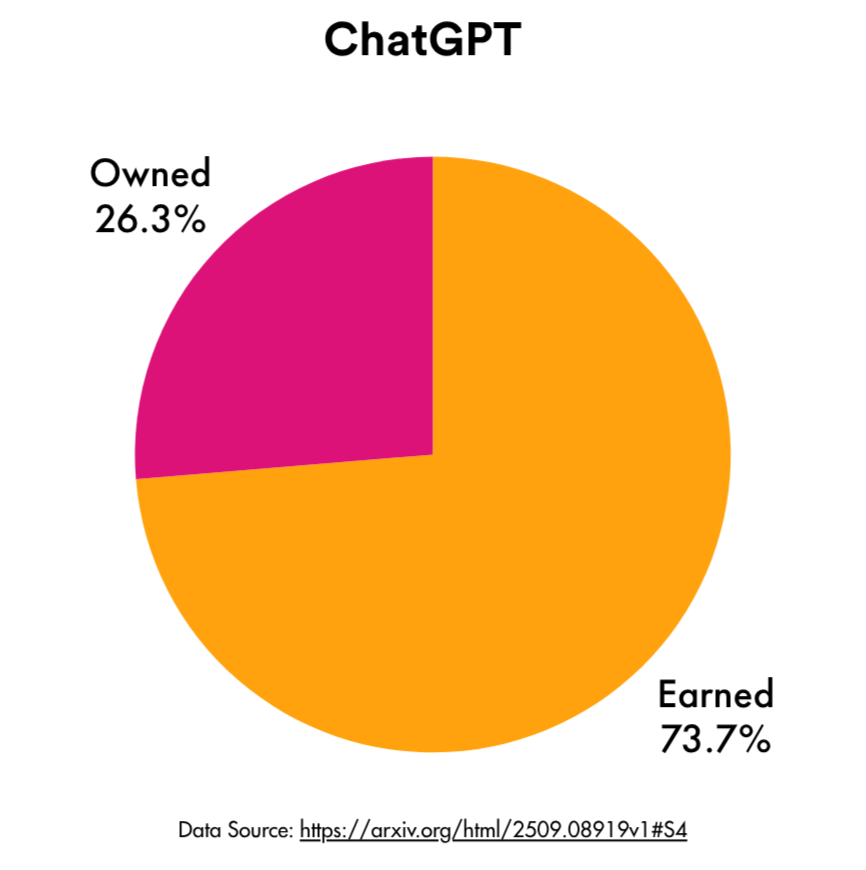
AI, it turns out, is different. The Toronto researchers found “a systematic and overwhelming bias towards earned media” when conducting AI searches, a bias far stronger than traditional SEO.
Now:
Researchers found that AI has a “systematic bias” toward earned media.
This chart shows ChatGPT’s sources for software product searches as tracked by Toronto researchers. Other markets show over 90% reliance on Earned media!
Why Do AI Models Rely on Earned Media?
This earned focus makes sense. AI models regularly require new information or inferences, fresh and updated data to better inform outputs. How AI is instructed to find and weight these inferences feels like a bit of a dark art, in that it’s not obvious how models are trained to evaluate sources. LLMs need to be guided carefully, as AI lacks the ability to evaluate real-life context. They don’t know what is a “good” inference and what is humorous, satirical, malicious, or just plain wrong. They just don’t know if gluing cheese on a pizza is a great tip or a very goofy joke.
For this reason, LLMs are trained to seek out verified sources that are more likely to be accurate, timely, and well grounded in fact. In other words, they’re looking for something that sounds a whole lot like traditional journalism.
Which is why LLMs lean heavily on traditional media to source new information, including about you and your company. We’re talking very traditional, including news services like Reuters and AP, and sometimes news wires, which do seem to have a positive impact on AI search, at least based on anecdotal evidence we’ve gathered.
However, there are people out there who suggest that you can inject whatever gobbledygook you want into the system, much as SEO hackers did in the past with high-volume, low-value web content.
We reveal the truth behind those stories and how you can update your SEO strategy for the age of AI in our new white paper, Acing AI Search!
Build your profile:
Find out how we can build a strategic Earned Media plan for your company and raise your profile in AI Search. Get the conversation started.
See how tech companies in music, media, and entertainment have grown thanks to RPS’s integrated PR and Marketing services. Read our Success Stories.
Get more free downloads to help you build your company and your brand.
About Tristra Newyear:

As Chief Writer, Tristra guides PR idea generation, bringing big-picture thinking and industry insights to the conversation. Tristra has been a creative force at Rock Paper Scissors for decades, crafting stories for clients at every stage of the business cycle and in many music innovation niches, from B2B back-end services to DTC music-making gear. With over 20 years of writing, editing, and research experience plus a PhD to her name, she’s known for synthesizing copious amounts of knowledge at the speed of light. Tristra’s work is driven by a love of music that stems from her days as a record store employee, continuing through her career as a singer and performing arts pro, and into her life as a publicist.
About Rock Paper Scissors:

Founded in 1999, Rock Paper Scissors, Inc. is a PR and marketing firm composed of a diverse team of communicators, creatives, and business minds. We have represented thousands of entertainment tech projects from six continents. Our roster includes clients in music technology, sports technology, entertainment technology, wellness tech, consumer electronics, innovative musical instruments and gear, AI music, consumer apps, and much more.
